
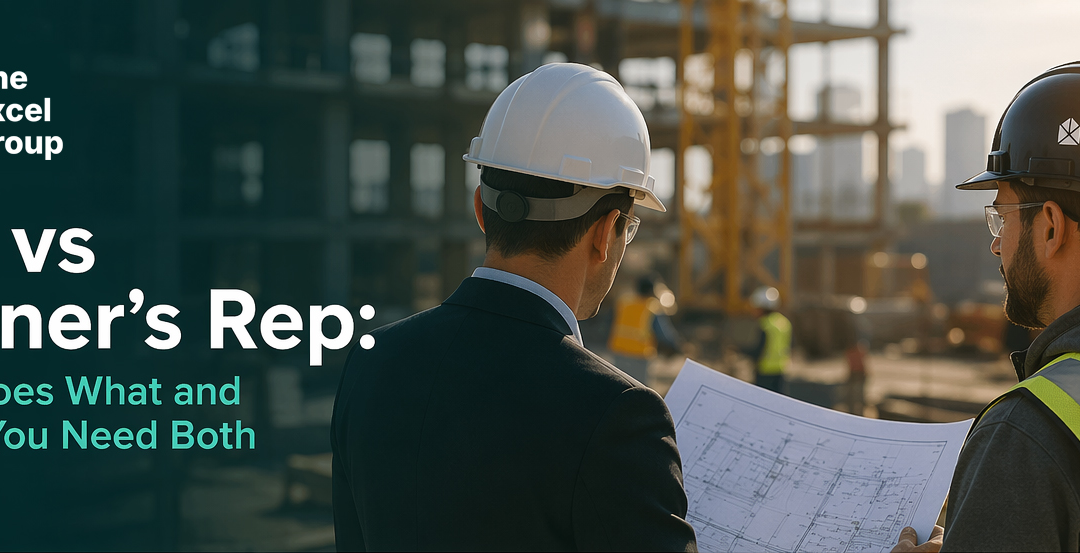
GC vs Owner’s Rep: Who Does What and When You Need Both
For owners, developers, and portfolio managers, one of the most important early decisions in a project is determining the right leadership structure. Understanding the difference between an owner’s rep vs general contractor can directly impact how smoothly a project progresses from planning through construction.
Whether you are evaluating an owner’s representative in NYC or coordinating with a general contractor NYC team, clarity around roles and responsibilities is critical to avoiding misalignment, delays, and cost overruns.
At The Excel Group, projects are approached with a structured, advisory-first mindset. Across commercial and residential work throughout NYC and East Coast markets, the focus is on clear accountability, disciplined coordination, and effective construction project delivery.
This guide breaks down how these roles function, when each is needed, and how they work together to support successful outcomes.
What Is a General Contractor?
A general contractor is responsible for executing the physical construction of a project.
Typical responsibilities include:
- Managing subcontractors and trades
- Overseeing on-site construction activities
- Coordinating materials, labor, and scheduling
- Maintaining site safety and compliance
- Delivering the project according to construction documents
In most commercial build-outs and residential construction projects, the general contractor team is the entity responsible for turning plans into a completed space.
What Is an Owner’s Representative?
An owner’s representative, often referred to as an owner’s rep construction role, acts on behalf of the owner to provide oversight, coordination, and strategic guidance throughout the project.
Typical responsibilities include:
- Representing the owner’s interests across all phases
- Coordinating between architects, engineers, and contractors
- Monitoring budgets, schedules, and risk factors
- Supporting procurement and contract management
- Providing objective oversight and accountability
For many projects, particularly in NYC and complex East Coast construction environments, an experienced owner’s representative NYC team helps bring structure and clarity to decision-making.
Owner’s Rep vs General Contractor: Key Differences
Understanding the difference between an owner’s rep vs general contractor is essential when defining how your project will be managed.
Primary Focus
- General Contractor: Executes construction
- Owner’s Rep: Oversees strategy, coordination, and alignment
Who They Represent
- General Contractor: Responsible for delivering the project
- Owner’s Rep: Represents the owner’s interests
Level of Involvement
- General Contractor: Primarily active during construction
- Owner’s Rep: Involved from early planning through closeout
Decision-Making Role
- General Contractor: Executes within defined scope
- Owner’s Rep: Helps guide decisions and reduce risk
Both roles are critical, but they serve fundamentally different purposes.
When You Need a General Contractor
A general contractor NYC team is essential for any project that involves physical construction.
You will need a general contractor when:
- Construction work is required
- Multiple trades must be coordinated
- On-site supervision is needed
- Safety and compliance must be managed
Without a qualified general contractor, a project cannot move forward into execution.
When You Need an Owner’s Representative
Not every project requires an owner’s rep, but many benefit from one.
You should consider an owner’s rep when:
- The project is complex or multi-phase
- You need help managing consultants and contractors
- Internal resources are limited
- You want additional oversight on budget and schedule
- You are managing multiple stakeholders
Knowing when to hire an owner’s rep can significantly improve project outcomes by reducing risk and improving coordination.
Why Many Projects Require Both
In many commercial and residential projects, the most effective structure includes both an owner’s representative and a general contractor.
This approach allows:
- The general contractor to focus on execution
- The owner’s rep to focus on alignment and oversight
Successful construction project management services in NYC projects often rely on this dual structure to maintain accountability and reduce coordination gaps.
Rather than overlapping roles, each serves a distinct function that supports overall project success.
Avoiding Common Coordination Breakdowns
Projects often run into issues when roles are not clearly defined.
Common problems include:
- Misaligned expectations between stakeholders
- Gaps in communication
- Budget tracking inconsistencies
- Schedule conflicts
- Change order disputes
Clear role definition at the beginning of a project helps prevent these issues and supports smoother construction project delivery.
Commercial and Residential Applications
The relationship between owner’s reps and general contractors applies across both commercial and residential projects.
In commercial environments:
- Office build-outs
- Retail rollouts
- Financial institution construction
In residential development:
- Ground-up construction
- Renovations and repositioning
- Multi-unit or phased projects
Across both sectors, structured oversight combined with strong execution leads to more predictable outcomes.
Start With the Right Structure
Choosing between an owner’s rep and a general contractor is not always an either-or decision. In many cases, the best results come from understanding how both roles function together.
If you are planning a project and evaluating the right structure, early alignment is key. Talk to our advisory team to discuss your project and determine the right approach.
You can contact us for an Owner’s Rep readiness checklist to better understand how these roles support your project from start to finish.
REFERENCES:
- Construction Management Association of America (CMAA)
https://www.cmaanet.org - Project Management Institute (PMI)
https://www.pmi.org - U.S. General Services Administration (GSA)
https://www.gsa.gov/real-estate/design-construction - National Institute of Building Sciences
https://www.nibs.org