
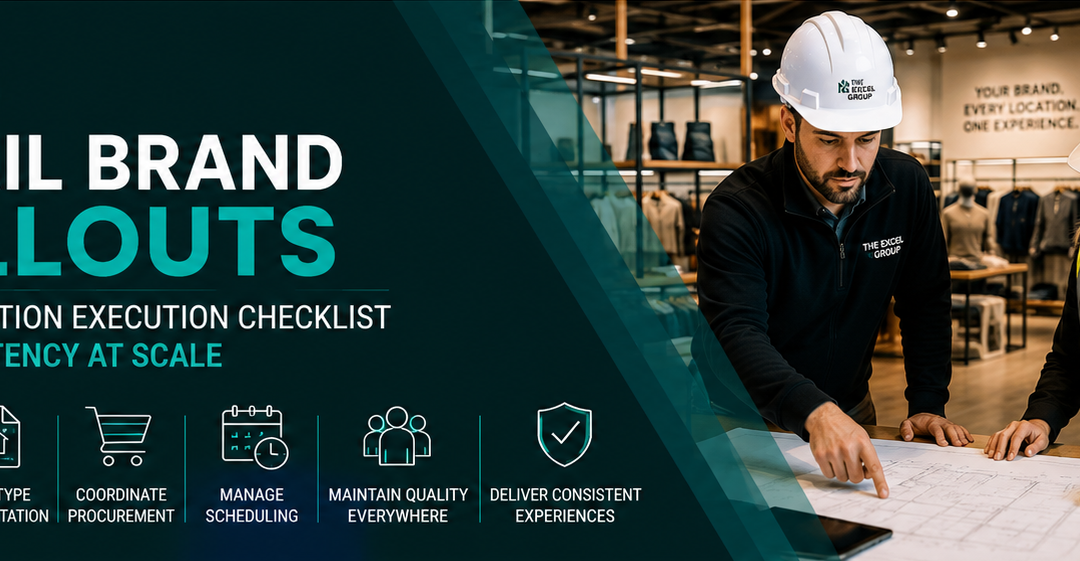
Retail Brand Rollouts: A Construction Execution Checklist for Consistency at Scale
Retail brands invest significant time and resources developing a customer experience that reflects who they are. Every store is expected to communicate the same identity through its layout, finishes, lighting, fixtures, signage, and overall appearance, whether it is the first location or the hundredth.
Maintaining that consistency becomes increasingly challenging as brands expand into multiple markets. Different municipalities have different permitting requirements. Existing building conditions vary. Local subcontractors, delivery schedules, and site logistics can all affect execution. Without a disciplined construction process, even well-developed brand standards can begin to drift from one location to the next.
Successful retail brand rollouts depend on more than quality construction. They require detailed planning, standardized processes, consistent communication, and disciplined execution across every location.
At The Excel Group, rollout projects are approached with a planning-first mindset that aligns pre-construction, project management, scheduling, procurement, and field execution. The objective is to create repeatable systems that deliver consistent results while adapting to the realities of each individual site.
This guide outlines a practical construction execution checklist that helps retail owners, developers, and store development teams maintain consistency at scale.
Why Consistency Matters in Retail Construction
Customers expect a familiar experience every time they walk into one of your locations.
Whether visiting a flagship store in Manhattan or a new location elsewhere on the East Coast, customers notice when details are inconsistent.
Differences in lighting, flooring, fixtures, millwork, signage placement, paint colors, or finishes may seem minor individually, but collectively they affect how customers perceive the brand.
Consistency also matters operationally.
Standardized construction helps simplify:
- Future maintenance
- Employee training
- Replacement materials
- Vendor coordination
- Facility management
- Capital planning
A successful retail build-out contractor understands that construction is not simply about completing individual projects. It is about protecting the integrity of an entire brand program.
Common Challenges During Multi-Location Rollouts
As brands expand, complexity increases rapidly.
Some of the most common challenges include:
- Different landlord requirements
- Varying municipal permitting processes
- Existing building conditions
- Long-lead material procurement
- Regional labor availability
- Multiple architects or consultants
- Inconsistent subcontractor quality
- Schedule compression
- Budget control across multiple projects
Without standardized systems, these variables often create inconsistencies that become more difficult to correct later.
Strong construction management helps identify these risks before they begin affecting quality, schedule, or brand standards.
Step 1: Start With Clearly Defined Brand Standards
Every successful rollout begins with documentation.
Construction teams cannot consistently build what has not been clearly defined.
Brand standards should include:
- Architectural finish standards
- Fixture specifications
- Millwork details
- Lighting requirements
- Flooring selections
- Ceiling systems
- Paint schedules
- Signage requirements
- Accessibility standards
- Technology requirements
- Furniture specifications
- Customer circulation requirements
The more complete the documentation, the fewer field decisions must be made during construction.
Reducing interpretation improves consistency.
Step 2: Standardize the Pre-Construction Process
One of the biggest advantages of repeat retail programs is the opportunity to standardize planning.
Effective pre-construction planning should establish consistent procedures before construction begins on every location.
This includes:
- Existing condition reviews
- Scope verification
- Budget validation
- Schedule development
- Procurement planning
- Permit tracking
- Utility coordination
- Risk identification
A repeatable pre-construction process allows project teams to solve problems before they reach the job site.
It also creates better forecasting across multiple projects.
Step 3: Develop Prototype Documentation
Many successful retail programs rely on prototype documentation.
Rather than redesigning each location from the ground up, the project team begins with a standard prototype and adjusts only where local conditions require.
Prototype documents typically include:
- Standard floor plans
- Fixture layouts
- Finish schedules
- Equipment locations
- Construction details
- Brand-specific architectural features
This approach reduces design time while improving consistency between locations.
It also simplifies estimating, procurement, and contractor coordination.
Step 4: Plan Procurement Early
Material availability can quickly become one of the largest risks during a rollout program.
Long-lead items such as lighting, millwork, specialty finishes, storefront systems, and custom fixtures often determine whether schedules remain on track.
Successful rollout teams identify these items early and coordinate purchasing before construction begins.
Planning procurement early allows teams to:
- Reduce schedule risk
- Improve budget predictability
- Coordinate fabrication
- Avoid last-minute substitutions
- Maintain brand consistency
Late substitutions frequently introduce unnecessary variation between locations.
Strong procurement planning helps prevent those situations.
Step 5: Coordinate Construction Sequencing
Every location may present unique challenges, but the overall construction sequence should remain as consistent as possible.
Standard sequencing helps project teams:
- Coordinate subcontractors more efficiently
- Improve scheduling accuracy
- Reduce trade conflicts
- Maintain quality expectations
- Improve communication between locations
When every project follows the same overall roadmap, lessons learned from one site can immediately improve the next.
Consistency becomes cumulative rather than isolated.
Step 6: Establish Clear Communication Protocols
Retail rollouts involve many stakeholders.
Depending on the project, participants may include:
- Ownership representatives
- Store development teams
- Architects
- Engineers
- Landlords
- Municipal agencies
- General contractors
- Specialty subcontractors
- Fixture vendors
- Technology providers
Without structured communication, information quickly becomes fragmented.
Successful rollout programs establish standardized reporting for every location, including:
- Weekly progress reports
- Budget updates
- Procurement tracking
- Schedule updates
- Open issue logs
- Quality observations
- Risk tracking
Consistent reporting allows leadership teams to compare projects accurately and identify trends before they become larger issues.
Step 7: Protect Quality Through Standardized Inspections
Quality control should never depend solely on the experience of individual field personnel.
Instead, successful rollout programs establish standardized inspection procedures that apply to every location.
These may include:
- Pre-installation meetings
- Mock-up reviews
- Material verification
- Installation checklists
- Progress inspections
- Punch list procedures
- Final turnover documentation
Standard inspections help ensure every completed location reflects the same level of craftsmanship, regardless of where it was built.
They also reduce rework and improve closeout efficiency.
Why Program-Level Management Matters
One of the biggest differences between constructing a single retail location and managing a rollout program is visibility.
Individual project managers naturally focus on the success of their specific project.
Program leadership must evaluate the performance of the entire rollout.
That broader perspective includes:
- Budget performance across all locations
- Schedule trends
- Procurement efficiency
- Quality consistency
- Vendor performance
- Risk management
- Lessons learned
- Continuous process improvement
Rather than solving the same problem repeatedly, successful rollout programs capture knowledge and improve the process from one project to the next.
Step 8: Standardize Project Closeout
A successful retail rollout does not end when construction is complete. Consistent project closeout ensures every location is fully operational, documented, and ready for long-term maintenance.
A standardized closeout process should include:
- Final inspections
- Completion of all punch list items
- As-built documentation
- Operations and maintenance manuals
- Equipment warranties
- Training for store personnel, when applicable
- Final permit approvals
- Turnover documentation
Standardized closeout procedures help reduce operational disruptions after opening and provide facilities teams with the information they need to maintain the space efficiently.
Step 9: Evaluate and Improve After Every Location
One of the greatest advantages of a multi-location construction program is the ability to learn from every completed project.
Each new location provides valuable data that can improve future execution.
Project teams should regularly review:
- Schedule performance
- Budget variances
- Procurement timelines
- Quality observations
- Subcontractor performance
- Permit challenges
- Material availability
- Lessons learned
Even small improvements, when repeated across dozens of projects, can result in significant savings in time and cost while improving overall consistency.
Continuous improvement transforms a rollout from a collection of individual projects into a scalable construction program.
The Role of Construction Management in Retail Rollouts
Executing a successful retail rollout requires more than coordinating contractors. It requires leadership, planning, communication, and disciplined execution from project inception through final turnover.
Experienced construction management teams provide oversight that helps ensure every location aligns with the owner’s objectives while proactively managing schedule, budget, quality, and risk.
At The Excel Group, construction management is built around repeatable processes that support consistency across multiple projects. Through comprehensive pre-construction services, project management, procurement coordination, quality oversight, and project delivery, our team helps clients execute complex retail programs with confidence throughout the East Coast.
Whether expanding into new markets, renovating existing stores, or managing phased brand refreshes, a structured construction approach helps protect both the customer experience and the long-term value of every location.
Retail Brand Rollout Construction Checklist
Before launching your next retail construction program, confirm that your team has addressed the following:
☐ Brand standards are fully documented and current
☐ Prototype drawings have been reviewed and updated
☐ Pre-construction planning is complete
☐ Budget and schedule have been validated
☐ Long-lead materials have been identified and procured
☐ Permitting requirements have been confirmed
☐ Communication and reporting procedures are established
☐ Quality control inspections are standardized
☐ Project closeout documentation is defined
☐ Lessons learned will be documented for future locations
Following a standardized construction process helps reduce risk, improve efficiency, and deliver a consistent customer experience across every location.
Partner With The Excel Group
Whether you’re opening five locations or fifty, consistency is achieved through planning, communication, and disciplined execution.
The Excel Group provides comprehensive pre-construction services, project management, and construction oversight that help retail brands execute successful rollout programs throughout the East Coast. By combining strategic planning with experienced project leadership, we help clients deliver spaces that meet brand standards, control costs, and open on schedule.
If you’re planning a retail expansion or multi-location renovation program, contact The Excel Group to learn how our construction management team can support your next rollout.
REFERENCES:
- Construction Management Association of America (CMAA). Standards of Practice. https://www.cmaanet.org
- Whole Building Design Guide (WBDG). Project Management and Construction Guidance. https://www.wbdg.org
- Project Management Institute (PMI). A Guide to the Project Management Body of Knowledge (PMBOK® Guide). https://www.pmi.org
- International Code Council (ICC). Building Codes and Accessibility Requirements. https://www.iccsafe.org
- U.S. Small Business Administration. Planning and Managing Business Expansion. https://www.sba.gov