
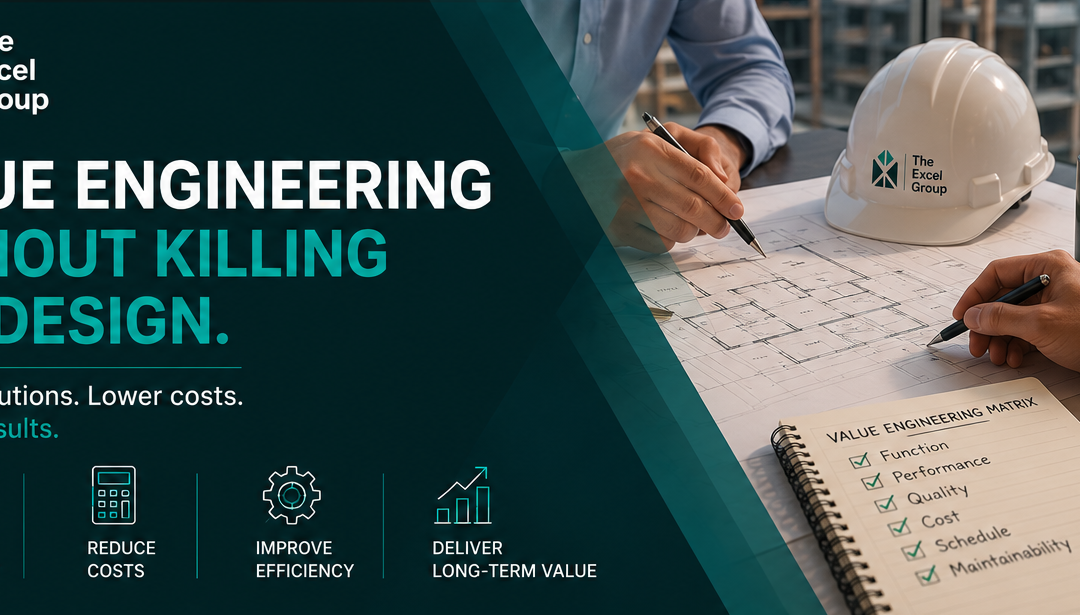
Value Engineering Without Killing the Design
When construction costs begin to rise, the instinctive response is often to start removing features, replacing finishes, or simplifying details. That may lower the initial price, but it can also weaken the design, reduce performance, and compromise the experience the space was intended to create.
Effective value engineering in construction should do something different. It should examine how a project achieves its required functions, identify more efficient ways to deliver those functions, and protect the priorities that matter most to the owner.
For commercial property owners, owner project managers, architects, and retail development teams, the goal is not simply to spend less. It is to use the available budget more intelligently.
At The Excel Group, value engineering is approached as a structured part of pre-construction planning. By evaluating scope, materials, systems, sequencing, logistics, and constructability before decisions become expensive to change, project teams can pursue meaningful savings while protecting design intent, brand standards, operational needs, and long-term performance.
This guide explains how a disciplined value engineering process can reduce unnecessary costs without reducing the project to a lesser version of the original design.
What Is Value Engineering in Construction?
Value engineering in construction is a systematic process used to evaluate a project’s required functions and determine whether those functions can be delivered more efficiently.
It is not simply a request to find cheaper products.
A responsible process considers the relationship among:
- Function
- Performance
- Quality
- Safety
- Cost
- Schedule
- Maintenance
- Design intent
The objective is to find the best overall value, rather than the lowest initial price.
For example, replacing a specified material with a less expensive alternative may create an immediate saving. However, that substitution is not a strong value engineering decision if the alternative wears out faster, requires more maintenance, delays procurement, or fails to support the visual standards of the space.
True value engineering asks a broader question:
Is there a more efficient way to achieve the same required outcome?
Why Value Engineering Gets a Bad Reputation
Value engineering often develops a negative reputation when it begins too late or is treated as a rushed cost-cutting exercise.
By the time a project is over budget, the design may already be complete, stakeholders may be attached to specific decisions, and procurement may be approaching. Under those conditions, the conversation can become a list of items to remove rather than a thoughtful review of value.
Common mistakes include:
- Cutting visible design features without understanding their importance
- Replacing materials based only on purchase price
- Reducing scope without evaluating operational effects
- Making substitutions without architect or consultant review
- Ignoring maintenance and life-cycle implications
- Accepting savings that create schedule or coordination problems elsewhere
This approach may reduce a line item while introducing new costs, performance concerns, or design compromises.
The better time to begin commercial construction value engineering is during pre-construction, when the team can compare alternatives before documents, approvals, and procurement decisions become difficult to revise.
Step 1: Define What the Design Must Protect
Before proposing savings, the project team needs to understand which elements are essential.
These priorities may include:
- Brand identity
- Customer or occupant experience
- Operational performance
- Durability
- Acoustic requirements
- Lighting quality
- Energy performance
- Security
- Code compliance
- Schedule commitments
- Signature architectural details
Not every feature has equal importance.
In a flagship retail environment, custom millwork, lighting, and finish transitions may be central to the brand experience. In a corporate interior, acoustics, workplace functionality, and employee comfort may carry greater weight. In a financial institution, security systems, customer flow, and durable finishes may be non-negotiable.
A productive value engineering process distinguishes protected priorities from areas where the team has greater flexibility.
Without that distinction, cost reduction can become arbitrary.
Step 2: Study Function Before Selecting Alternatives
The strongest value engineering conversations begin with function.
Instead of asking, “What can we remove?” the team should ask:
- What is this element required to do?
- Why was this material or system selected?
- What performance standard must it meet?
- Is there another way to deliver the same function?
- Would an alternative affect appearance, maintenance, schedule, or quality?
- Does the proposed change create consequences for another trade or system?
This functional approach helps the team identify savings that may not be visible to occupants or customers.
For example, the team may find a more efficient assembly, installation method, structural approach, mechanical routing strategy, or procurement sequence that preserves the finished design while reducing labor, material waste, or schedule exposure.
These are often stronger solutions than simply downgrading finishes.
Step 3: Begin During Pre-Construction
The earlier value engineering begins, the more options the team generally has.
During value engineering during pre-construction, owners, architects, consultants, estimators, and construction professionals can evaluate cost and constructability while the design is still developing.
This allows the team to:
- Compare materials before specifications are finalized
- Review alternative assemblies
- Identify difficult or labor-intensive details
- Evaluate procurement lead times
- Coordinate building systems earlier
- Identify opportunities for prefabrication or standardization
- Test the design against current budget information
- Resolve conflicts before construction begins
Early review also allows architects to participate meaningfully in the decision-making process. Their involvement is essential when proposed alternatives may affect design intent, technical performance, or the coordination of surrounding elements.
Step 4: Evaluate Total Cost, Not Just Purchase Price
A lower initial price does not always create better value.
Each proposal should be evaluated for its effect on:
- Installation labor
- Procurement lead time
- Maintenance
- Replacement frequency
- Energy or operational use
- Warranty coverage
- Schedule
- Availability
- Coordination with other systems
- Long-term performance
Consider two flooring materials. One may have a lower purchase price but require more preparation, specialized installation, or frequent replacement. The other may cost more initially but provide greater durability and lower maintenance demands.
The right decision depends on the project’s priorities, expected use, schedule, and ownership horizon.
This is why responsible construction cost reduction considers both immediate and longer-term consequences.
Step 5: Protect the Design Hierarchy
Every design has a hierarchy.
Some elements shape the identity and experience of the entire space. Others support the design but can be adjusted with little visible impact.
The project team should identify:
Design-defining elements
These may include:
- Feature walls
- Customer-facing finishes
- Signature lighting
- Custom millwork
- Branded architectural details
- Primary public spaces
Supporting elements
These may include:
- Back-of-house finishes
- Concealed assemblies
- Repetitive details
- Secondary materials
- Installation methods
- Non-public support spaces
This does not mean supporting elements are unimportant. They must still meet functional, safety, quality, and durability requirements. It means the project team can prioritize its effort and budget more intentionally.
For teams researching how to reduce construction costs without sacrificing design, this hierarchy is one of the most useful tools available.
Step 6: Compare Proposals Using a Value Engineering Matrix
A value engineering matrix helps stakeholders compare options consistently instead of making decisions based on a proposed saving alone.
Each proposal should document:
- Original design or specification
- Proposed alternative
- Reason for the change
- Estimated cost effect
- Schedule effect
- Design effect
- Performance effect
- Maintenance considerations
- Required consultant approvals
- Decision status
Useful value engineering examples might include:
- Revising an assembly to reduce unnecessary labor while preserving its appearance
- Standardizing concealed components across multiple locations
- Selecting a readily available material with comparable performance
- Adjusting dimensions to reduce custom fabrication
- Coordinating mechanical or electrical routing to avoid rework
- Revising project phasing to improve trade efficiency
- Using mockups to resolve complex details before full installation
A matrix makes the tradeoffs visible and creates a record of why each proposal was accepted or rejected.
Step 7: Include the Right Decision-Makers
Value engineering works best as a collaborative process.
Depending on the project, participants may include:
- Owner representatives
- Architects
- Engineers
- Construction managers
- General contractors
- Estimators
- Specialty consultants
- Facilities or operations leaders
- Retail or brand representatives
No single participant has a complete view of every consequence.
The contractor may identify a more efficient installation method. The architect may recognize that it changes a critical visual relationship. The facilities team may know that a proposed product creates an unacceptable maintenance burden. The owner may determine that a particular brand feature must remain protected.
A multidisciplinary review helps prevent one-dimensional decisions.
What Good Value Engineering Should Produce
A disciplined process should produce more than a list of deductions.
It should provide:
- Clear alternatives
- Documented advantages and disadvantages
- Cost and schedule implications
- Design and performance considerations
- Defined approval responsibilities
- A record of accepted decisions
- Updated budget information
The strongest proposals improve the balance among scope, quality, function, schedule, and cost.
Some proposals may reduce cost. Others may improve constructability, limit risk, shorten the schedule, or increase long-term value. Some may be rejected because their savings do not justify the design or performance impact.
Rejecting a poor proposal is also part of good value engineering.
Commercial Applications
Value engineering can support a wide range of commercial environments, including:
- Corporate interiors
- Tenant improvements
- Retail stores and brand rollouts
- Hospitality spaces
- Financial institutions
- Mixed-use commercial spaces
- Phased renovations
- Occupied-building upgrades
In retail construction, value engineering may focus on maintaining brand consistency across multiple locations while improving fabrication, sourcing, and installation efficiency.
In corporate interiors, it may involve balancing workplace quality, technology, acoustics, durability, and budget.
In hospitality environments, it may focus on preserving guest-facing design while identifying efficiencies in repetitive rooms, concealed systems, and back-of-house areas.
The correct approach depends on the function and priorities of the project.
Value Engineering Without Compromising the Project
The best value engineering decisions are often the ones that occupants never notice.
The space still looks intentional. The systems still perform. The project still supports the owner’s goals. The difference is that the team found a more efficient way to deliver it.
That outcome requires early planning, current cost information, design-team involvement, disciplined comparison, and clear documentation.
It also requires resisting shortcuts that create immediate savings but weaken the project over time.
Start With the Right Priorities
Value engineering should not begin by asking what can be eliminated.
It should begin by defining what the project must accomplish, what the design must protect, and where greater efficiency may be possible.
If you are planning a commercial interior, retail project, tenant improvement, or phased renovation, early value engineering can help align scope, design, schedule, and budget before construction begins.
Talk to our team about your project priorities and budget goals. You can also request a value engineering matrix template to help organize proposals, compare tradeoffs, and document decisions.
REFERENCES:
- SAVE International, About the Value Methodology
https://www.value-eng.org/page/AboutVM - SAVE International, Value Standards
https://www.value-eng.org/page/ValueStandards - Whole Building Design Guide, Value Engineering
https://www.wbdg.org/article/design-objectives/cost-effective/value-engineering - Whole Building Design Guide, Utilize Cost and Value Engineering Throughout the Project Life Cycle
https://www.wbdg.org/article/design-objectives/cost-effective/utilize-cost-value-engineering - Construction Management Association of America, Value Engineering Standards of Practice
https://www.cmaanet.org/elearning/value-engineering-sop