
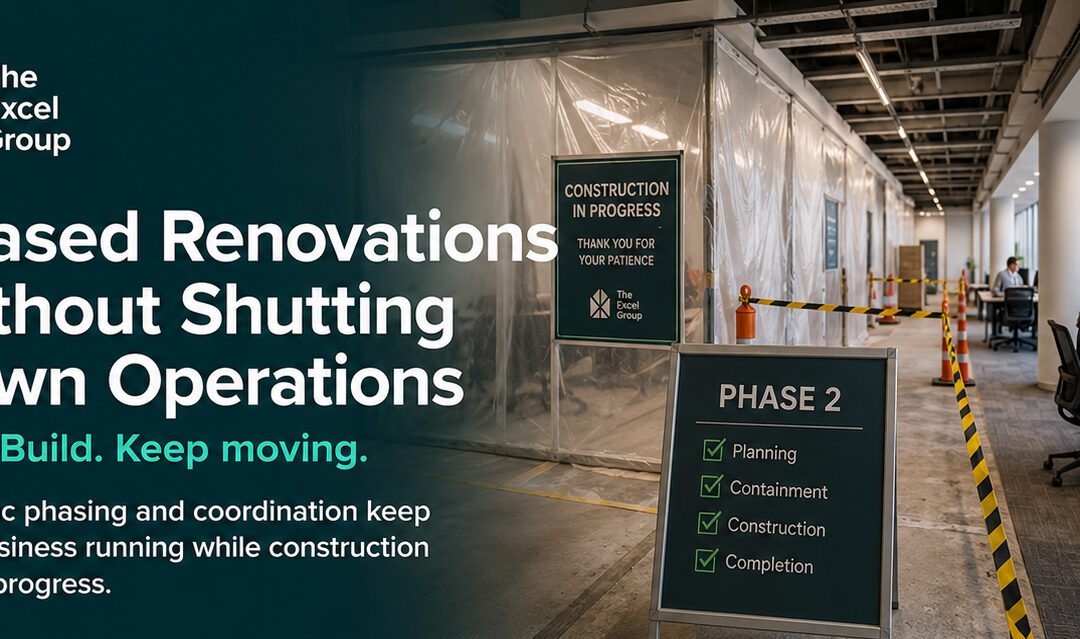
Phased Renovations Without Shutting Down Operations
For owners, tenants, and facilities teams, one of the biggest concerns during renovation projects is maintaining operations while construction is underway. A well-planned phased renovation in an occupied building allows organizations to continue functioning while minimizing disruption, safety risks, and operational downtime. Whether you are managing a commercial office renovation, tenant improvement project, financial institution upgrade, or residential repositioning effort, the ability to coordinate construction around ongoing activity is critical. Across NYC and East Coast construction markets, projects in occupied spaces require significantly more planning, communication, and sequencing than traditional renovations. At The Excel Group, occupied-space projects are approached through structured coordination, disciplined scheduling, and proactive operational planning designed to keep construction moving while supporting day-to-day functionality. This guide breaks down how phased renovations are planned and executed without shutting down operations.
What Is a Phased Renovation?
A phased renovation is a construction approach where work is completed in carefully sequenced stages rather than all at once. This strategy is commonly used in:
- Office environments
- Financial institutions
- Hospitality properties
- Healthcare facilities
- Retail environments
- Multi-unit residential projects
In most cases, occupied space construction is designed to allow portions of a building to remain operational while construction progresses in controlled area.
Why Occupied Renovations Require More Planning
Construction in active environments introduces operational and logistical challenges that do not exist in vacant spaces. Common concerns include:
- Maintaining safe access for occupants
- Noise and dust control
- Protecting ongoing business operations
- Coordinating work around business hours
- Temporary utility interruptions
- Security and access management
Without strong phased construction planning, these issues can quickly create operational disruption, scheduling delays, and tenant frustration
Step 1: Establish Clear Phasing Strategy
One of the most important parts of successful tenant improvement phasing is establishing a clear sequence of work before construction begins. This process typically includes:
- Defining active vs construction zones
- Identifying operational priorities
- Sequencing demolition and build-out phases
- Coordinating temporary relocations if necessary
- Establishing safety barriers and access routes
The goal is to create a realistic operational roadmap before work begins in the field.
Step 2: Coordinate Around Business Operations
Strong operational coordination is essential during construction in occupied spaces. This often requires:
- Off-hours scheduling
- Weekend or night work
- Controlled delivery windows
- Noise-sensitive work coordination
- Temporary workflow adjustments
In many commercial renovation NYC projects, maintaining occupant communication throughout the project is just as important as the construction itself.
Step 3: Prioritize Communication Across Stakeholders
Occupied projects involve significantly more communication than traditional renovations. Successful projects rely on consistent coordination between:
- Owners
- Tenants
- Facilities teams
- Contractors
- Building management
- Consultants
Clear communication helps reduce confusion, improve scheduling coordination, and minimize disruption throughout project delivery.
Step 4: Implement Site Safety and Containment Measures
Safety becomes even more critical when buildings remain operational during construction. A strong occupied-building renovation strategy should include:
- Dust containment systems
- Temporary partitions and barriers
- Controlled access points
- Clear signage and wayfinding
- Emergency access coordination
- Ongoing housekeeping and cleanup protocols
These measures help protect occupants while allowing construction activities to continue efficiently.
Step 5: Maintain Scheduling Flexibility
Occupied-space projects rarely follow a perfectly linear schedule. Unexpected operational needs, tenant concerns, or building constraints often require adjustments throughout the project. Strong operational renovation planning allows teams to:
- Adapt sequencing when necessary
- Reallocate work zones efficiently
- Minimize downtime impacts
- Maintain schedule momentum despite changing conditions
Flexibility combined with disciplined coordination is often what determines whether an occupied renovation succeeds smoothly.
How Phased Renovations Reduce Operational Disruption
Owners often ask how to renovate without shutting down operations entirely. The answer comes down to planning, sequencing, and communication. The most successful occupied-space projects rely on:
- Early phasing strategy
- Clear communication protocols
- Realistic scheduling
- Strong site management
- Safety-first coordination
- Flexible execution planning
Across East Coast construction projects, structured phasing consistently helps organizations maintain continuity while construction progresses.
Commercial and Residential Applications
Phased renovation strategies apply across both commercial and residential environments. In commercial settings:
- Office build-outs
- Retail renovations
- Financial institution upgrades
- Hospitality repositioning
In residential projects:
- Multi-unit occupied renovations
- Condominium common area upgrades
- Phased residential repositioning
- Tenant-occupied renovations
Across both sectors, thoughtful planning allows projects to move forward without unnecessary operational shutdowns.
Start With a Realistic Operational Plan
Renovating an occupied building requires more than construction scheduling alone. The most successful projects balance operational continuity with disciplined execution from the earliest planning stages. If you are preparing for a renovation in an active environment, early coordination can significantly reduce disruption and improve project outcomes.
Talk to our team about your project goals, operational requirements, and phasing considerations. You can also request an occupied-space renovation planning checklist to better understand how phased projects are coordinated from planning through final delivery.
REFERENCES:
- Construction Management Association of America (CMAA) https://www.cmaanet.org
- OSHA Construction Safety Standards https://www.osha.gov/construction
- National Institute of Building Sciences https://www.nibs.org
- U.S. General Services Administration (GSA) https://www.gsa.gov/real-estate/design-construction
- Project Management Institute (PMI) https://www.pmi.org